Authentication
SASjs Server supports three authentication methods - Internal, LDAP, and OpenID Connect (OIDC).
These are selected with AUTH_PROVIDERS, which is a list - more than one may be enabled at once, for example LDAP for directory users together with OIDC for single sign-on.
Note that authentication is only available in server mode (not desktop).
Internal Authentication
By default, users are created using the internal database with a password configured by an admin. Groups can also be added, and permissions set against those groups.
Disabling the local password login
Where every account lives in an identity provider, the internal password path can be switched off entirely: set LOCAL_LOGIN_ENABLED to false and a local account cannot sign in at all, because the stored password is never compared. LDAP-verified sign-in and the provider's own sign-in keep working. The login screen hides the password form while it is off, leaving the provider's button as the only way in.
This matters most where the app is reachable without a browser sign-in. On Cloudron the app package closes the local password path by default: with single sign-on configured and no break-glass admin seeded, no local account exists to use it, and /SASLogon/login is reachable from the internet - so an exposed password form would be the one credential an anonymous caller could guess.
LDAP Authentication
SASjs Server can connect to an LDAP server (internally, we use the LDAPjs library). Any users / groups that are imported will be in addition to any internal users / groups. If there are conflicts, those particular users/groups will not be imported - to fix this, just delete the relevant (SASjs internal) users/groups and re-import.
Note that at least one internal admin user is necessary, to be able to log in and do the import. After this, the internal user may nominate other (LDAP) users as SASjs admins.
Configuration is made in the following .env settings:
AUTH_PROVIDERS=ldap
LDAP_URL= ldaps://LDAP_SERVER_URL:PORT
LDAP_BIND_DN= cn=admin,ou=system,dc=companyname
LDAP_BIND_PASSWORD = <password>
LDAP_USERS_BASE_DN = ou=users,dc=companyname
LDAP_GROUPS_BASE_DN = ou=groups,dc=companyname
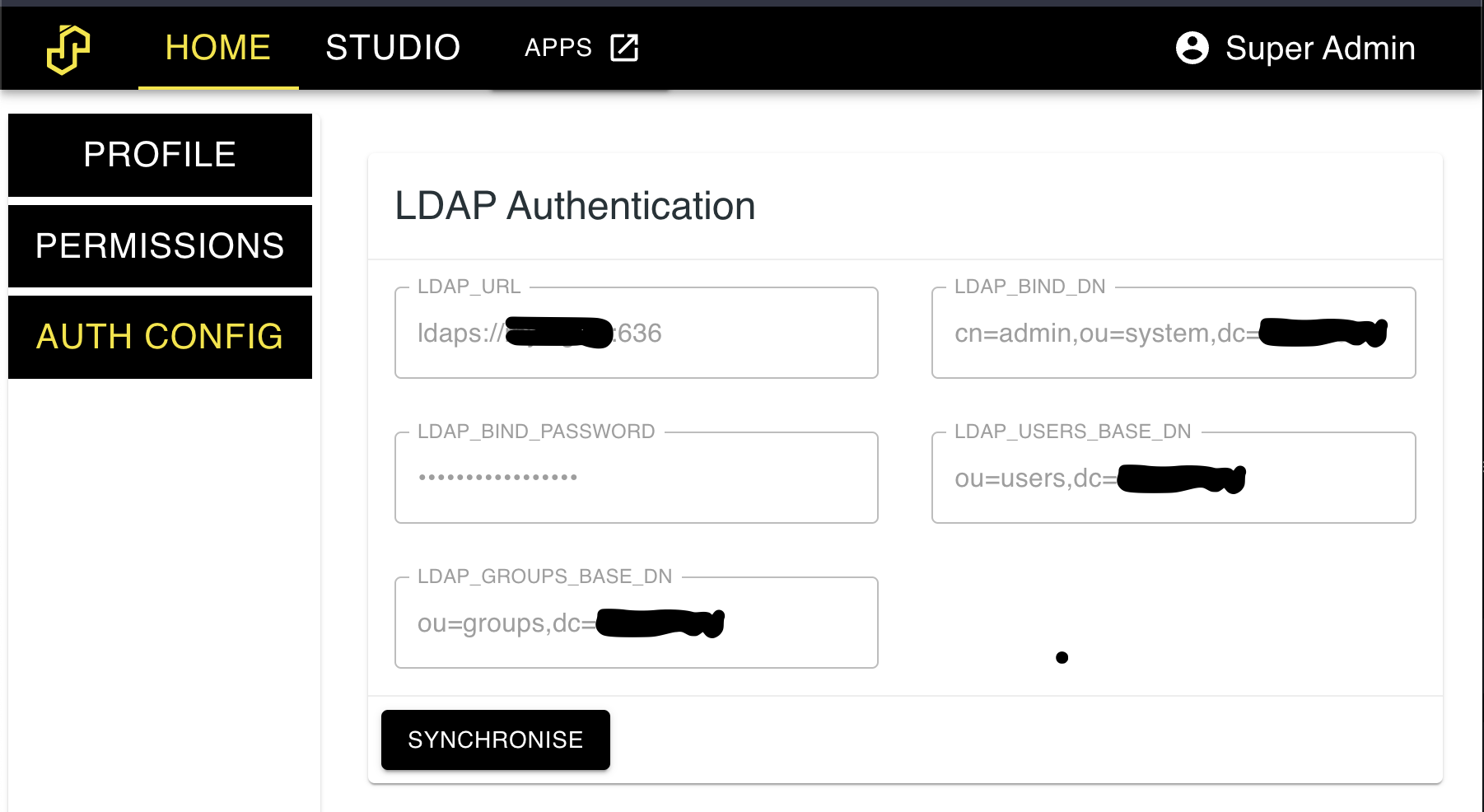
Next, restart the server and log in with the admin user. Navigate to the settings tab. You should see a screen like the below. Import the users & groups by clicking the 'synchronise' button.
OpenID Connect Authentication
SASjs Server can act as an OpenID Connect relying party, so users can sign in with any compliant provider (Okta, Entra ID, Keycloak, Google, Auth0, and so on). It is driven entirely by the provider's own discovery document, so no provider-specific code is involved - only configuration.
When OIDC is configured, a "Sign in with ..." button appears on the login screen automatically. The password form stays below it, so internal and LDAP users are unaffected - and a local admin can still sign in if the provider is unavailable.
Configuration
AUTH_PROVIDERS=oidc
OIDC_ISSUER_URL=https://id.example.com
OIDC_CLIENT_ID=sasjs-server
OIDC_CLIENT_SECRET=<client secret>
OIDC_REDIRECT_URI=https://sas.example.com/SASLogon/openid/callback
The endpoints are then read from <OIDC_ISSUER_URL>/.well-known/openid-configuration. If your provider does not serve discovery at that path, supply it directly with OIDC_DISCOVERY_URL instead.
Register OIDC_REDIRECT_URI with your provider as the callback URL - the full URL, including the /SASLogon/openid/callback path. It must match exactly.
The remaining settings are optional and are listed under Settings.
PKCE
Sign-in uses PKCE (RFC 7636) with the S256 challenge method: a per-attempt verifier is kept server-side, only its SHA-256 digest travels in the authorization request, and the code exchange sends the verifier - so a code intercepted in the browser cannot be redeemed by anything except the client instance that started the flow.
There is nothing to configure. The challenge is always sent, and your provider needs no extra registration for it; providers that require PKCE (some do, for confidential clients as well as public ones) are satisfied by it. It is also sent when the provider's discovery document does not advertise code_challenge_methods_supported - a provider that does not understand the parameter ignores it, whereas gating on that advertisement would be the downgrade the OAuth 2.0 Security Best Current Practice warns about.
How users are matched
The provider's sub claim is the durable identity. On each sign-in:
- The
subis looked up in the SASjs user table. A match signs that user in, regardless of what the username claim says. - Otherwise, the username claim (
preferred_usernameby default) is normalised to a SASjs username - lowercase, alphanumeric, up to 16 characters - and a user with that name is created, subject to the access policy below. - If a user with that normalised name already exists and is not already linked to that provider account, the sign-in is refused rather than adopting the account. This is deliberate: the existing account may hold a local password and be an administrator. An admin must resolve the clash (rename one of the two) before that person can sign in.
Access policy
Access is decided by the provider's groups claim, by fixed name:
| Membership | Result |
|---|---|
sasjs-admins |
signed in as a SASjs administrator |
sasjs-users |
signed in as an ordinary user |
| neither | refused, and no account is created |
The names are not configurable. Membership is the whole access decision, so a deployment that could rename the groups could silently change who gets in. Membership is re-read on every sign-in, so removing someone from sasjs-admins demotes them the next time they sign in rather than leaving the elevation in place.
The groups scope is requested automatically when the provider's discovery document advertises it, and the claim is read from the id_token with a fallback to the provider's userinfo endpoint, because providers differ on where they put it.
Providers that cannot express groups (Google, for example) are exempt from the policy, and the first user to sign in becomes the administrator. Refusing every user of such a provider would be worse than granting one account, and the exemption is keyed on the discovery document, so it cannot be switched on by accident.
Groups and permissions
Each sign-in mirrors the memberships the provider asserts onto SASjs groups of the same name, so a permission can be granted to a provider group rather than to each of its members in turn. The mirror is authoritative: a membership the provider stops asserting is removed at the next sign-in, so a revocation takes effect then rather than leaving the access the group granted in place.
Mirrored groups are marked as provider-managed, so their membership cannot be edited inside SASjs Server - it comes from the provider. A group name an administrator has already used locally, or one another provider owns, is left alone and reported in the server log rather than adopted: its members and the permissions pointing at it belong to whoever created it.
OpenID Connect reports the groups of the user who is signing in and offers no way to enumerate a directory, so this is a per-sign-in mirror rather than the bulk synchronisation LDAP allows. Permissions themselves are managed inside SASjs Server - see Authorisation.
Logout
The /SASLogon/openid/logout route clears the SASjs session and, when the provider advertises an end-session endpoint, redirects there so the single sign-on session is closed too.
Example: Cloudron
Cloudron's user directory is an OIDC provider, and its addon exports the values you need. Map them onto the generic settings - no Cloudron-specific code is involved:
AUTH_PROVIDERS=oidc
OIDC_ISSUER_URL=$CLOUDRON_OIDC_ISSUER
OIDC_DISCOVERY_URL=$CLOUDRON_OIDC_DISCOVERY_URL
OIDC_CLIENT_ID=$CLOUDRON_OIDC_CLIENT_ID
OIDC_CLIENT_SECRET=$CLOUDRON_OIDC_CLIENT_SECRET
OIDC_PROVIDER_NAME=$CLOUDRON_OIDC_PROVIDER_NAME
OIDC_REDIRECT_URI=https://$CLOUDRON_APP_DOMAIN/SASLogon/openid/callback
and declare the callback in the app manifest:
"addons": {
  "oidc": {
    "loginRedirectUri": "/SASLogon/openid/callback",
    "logoutRedirectUri": "/",
    "tokenSignatureAlgorithm": "RS256"
  }
}
Cloudron asserts the username as the sub claim and sends group memberships in the groups claim, so a Cloudron user's group membership decides access as described above - create sasjs-users and sasjs-admins under Users > Groups and assign people to them. Those groups then appear inside the app as well, which is what lets you grant permissions to the group instead of user by user.
Brute Force Protection
Failed password attempts are throttled by username. After MAX_LOGIN_FAILURES wrong passwords against one username, further attempts are refused with 429 Too Many Failed Attempts for LOGIN_LOCKOUT_MINUTES, whether or not the password is correct. A successful sign-in resets the counter.
The lockout is keyed on the username rather than the IP address: behind a reverse proxy every client shares the proxy's address, so an IP-keyed limit locks out the whole deployment rather than an attacker.
# failed attempts against one username before the login is refused
# default: 5
MAX_LOGIN_FAILURES = <number>

# how long the username stays locked out
# default: 15
LOGIN_LOCKOUT_MINUTES = <number>
Counters are held in process memory, so a server restart clears them. In the small, internal user base SASjs Server targets, a lockout is resolved by waiting out the window or asking an admin to restart.
Admin Account
There is no default password, and no account exists until one is created. To seed a local admin, set ADMIN_PASSWORD_INITIAL to a strong password; the account is named by ADMIN_USERNAME (default secretuser) and the password is in place until the first login.
In server mode the password is required unless an external auth provider is enabled: with a provider, leaving it unset seeds no local admin at all, and access is decided by the provider's groups - see Access policy.
If the admin password is misplaced, it can be reset by restarting the server with ADMIN_PASSWORD_RESET set to YES. Be sure to set it back to NO (or remove the option) to prevent the password being reset on any subsequent server restart.